Markets · Toys, Models & Dolls

Toy and doll sales where the box matters as much as the toy

Your bidders read a toy lot twice: once for the toy, once for the box. Auctionomy gives every lot room for both, on a website that carries your house's name rather than a marketplace's.

How your bidders buy

What your bidders read for

Toy and box are graded apart

Collectors expect the toy's condition and the box's condition stated separately, often on the familiar C-scale or as mint in box, near mint or played with. A crushed corner or a sun-faded lid moves an estimate as much as a chipped paint finish.
Completeness is part of the description

Missing keys, figures, inserts or instruction leaflets are what a specialist looks for first. A clockwork piece that runs, or a set with every carriage, needs saying in the lot itself.

Maker, material and type lead the title

Tinplate, diecast, composition, bisque or celluloid, by maker and date where known. Doll catalogues add costume, wig and body type, so a bidder can tell an original outfit from a later one.

Catalogued your way

Every line of the entry has its place

Description, estimate, condition and provenance are separate parts of every lot on Auctionomy, and each one shows on the lot page. The entry shown here is an illustration, written the way the trade writes it.

Illustrative lot · fictional

Lot 214. A German clockwork tinplate fire engine with ladder, circa 1910, in original box

Hand-painted red and gold livery, extending ladder and two seated firemen, key-wound motor. Original card box with printed label.

Estimate US$1,200–1,800

Condition
Toy C8: light paint loss to running boards, mechanism runs. Box C6: one end flap detached, fading to lid. Key not present.
Provenance
From a private Midwestern collection formed in the 1970s.

Your sale on Auctionomy

Run the way your house runs it

Condition notes for toy and box

Every lot carries a description, a condition note and provenance, shown on its own lot page. Write the toy's grade and the box's grade side by side, in your house's own scale.

Enough photographs to judge the box

Add as many images as a careful bidder needs: all six faces of the box, the underside, the mechanism and any repairs.

A catalogue arranged the way collectors browse

Set your own categories, from tinplate and diecast to dolls, puppets and board games, and let bidders filter, search and keep a watchlist of the lots they're tracking.

Timed sales for long collections

Run a large single-owner collection as a timed sale with your own increments. A late bid extends the close, so a contested lot isn't decided by the clock.

Your trade, your house

Fluent in the trade, and unmistakably yours

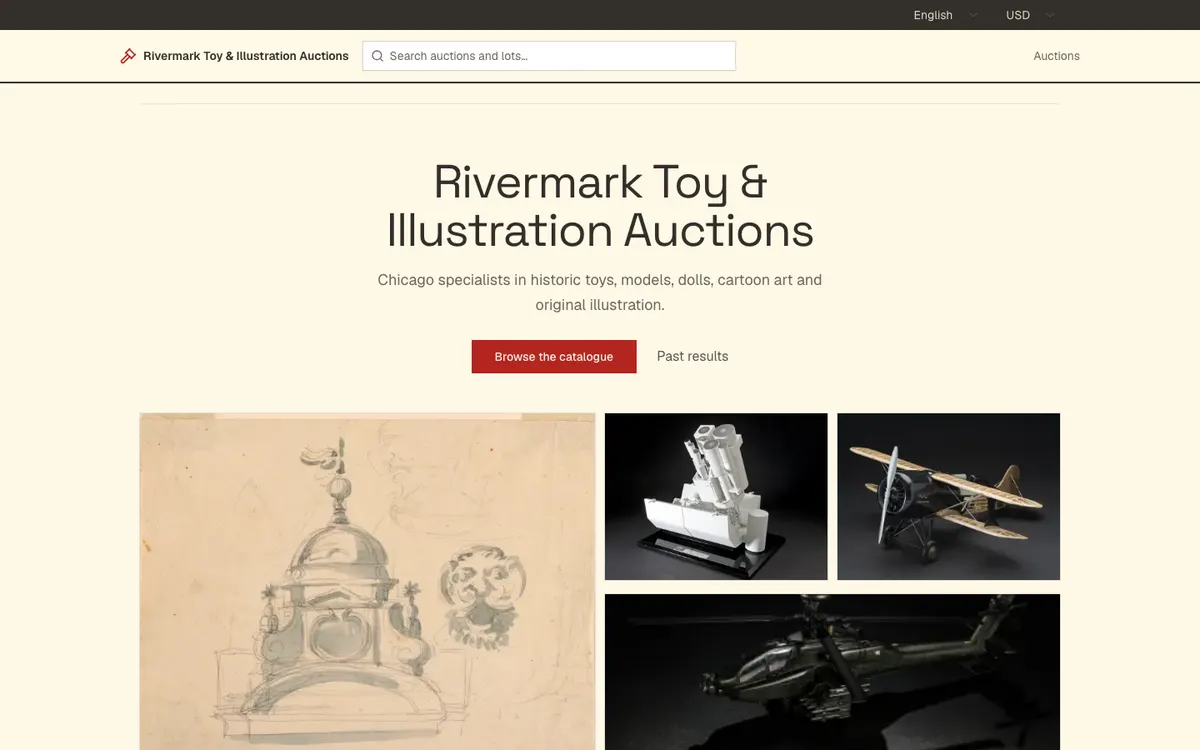
Rivermark Toy & Illustration Auctions is a demonstration house: fictional, built on Auctionomy to show how a house specialising in toys, models & dolls looks on the platform. Its name, colours, typeface and page layout are its own, assembled from the same components every house uses. Yours would carry your name, your logo and your look, on your own domain.

The homepage of Rivermark Toy & Illustration Auctions, a demonstration house built on Auctionomy
Rivermark Toy & Illustration Auctions, Chicago. A demonstration house; its lots are illustrations.Visit the demonstration site

No commission on the hammer price

A flat subscription, agreed with your house. Your bidders register with you, and the buyer's premium you set is yours.