Mark and period, or mark only
A six-character reign mark on a piece of that reign is catalogued as mark and period; the same mark on later work is not. Bidders read the distinction before anything else.
Markets · Asian Art
In Asian art one qualifier can separate a reign-marked piece from a later tribute. Auctionomy gives your house lot pages that hold that precision, and a website your bidders recognise as yours.
How your bidders buy
A six-character reign mark on a piece of that reign is catalogued as mark and period; the same mark on later work is not. Bidders read the distinction before anything else.
Ming or Qing, Edo or Meiji, Tibetan or Nepalese; then jade, bronze, lacquer, porcelain or ink on silk. Precise regional language is what specialist bidders search for.
Ivory, rhinoceros horn and tortoiseshell are restricted under CITES and national law, and rules differ between where your house sells and where a bidder lives. Your house checks each piece before it is offered.
Catalogued your way
Description, estimate, condition and provenance are separate parts of every lot on Auctionomy, and each one shows on the lot page. The entry shown here is an illustration, written the way the trade writes it.
Illustrative lot · fictional
Painted to the centre with a five-clawed dragon chasing a flaming pearl among clouds, the reverse with two further dragons. 20.5 cm diameter.
Estimate S$8,000–12,000
Your sale on Auctionomy
Each lot carries your exact title and description, so 'mark and period' and 'mark' stay where your specialist put them.
Add several images per lot: the base and its mark, the foot ring, the carving under raking light, any restoration.
A collection history, a dealer's label or an old inventory number goes in the provenance field, where bidders look for it first.
Define your own categories, such as Chinese ceramics, Japanese prints or Himalayan sculpture, and bidders filter your catalogue by them.
Your trade, your house
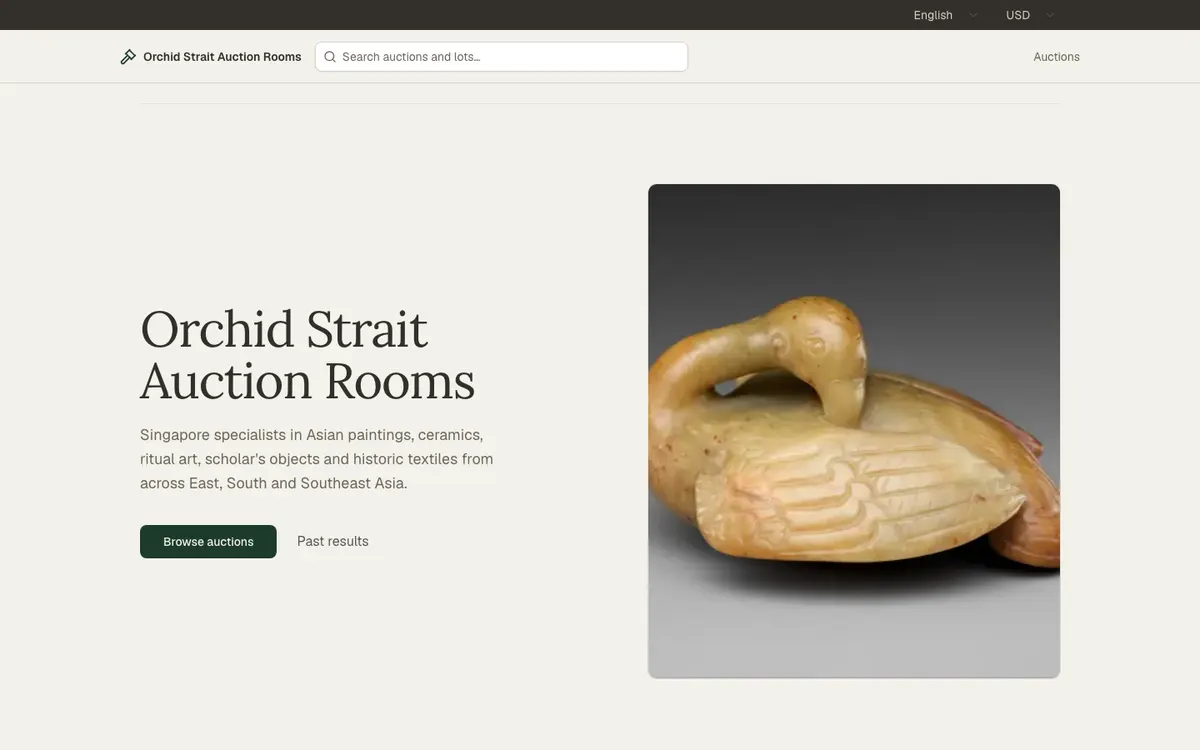
Orchid Strait Auction Rooms is a demonstration house: fictional, built on Auctionomy to show how a house specialising in Asian art looks on the platform. Its name, colours, typeface and page layout are its own, assembled from the same components every house uses. Yours would carry your name, your logo and your look, on your own domain.
A flat subscription, agreed with your house. Your bidders register with you, and the buyer's premium you set is yours.