
From consignment to the paid invoice
Auctionomy follows a sale the way your house already runs it. A seller's enquiry becomes a lot, the lot is catalogued once, the sale goes up on your website, bidders register with you, the sale runs to the clock or from the rostrum, and the buyer pays you.
1Consignment
Consignments arrive through your website
A seller fills in a request on your site, with photographs, and it reaches your dashboard for a specialist to review.
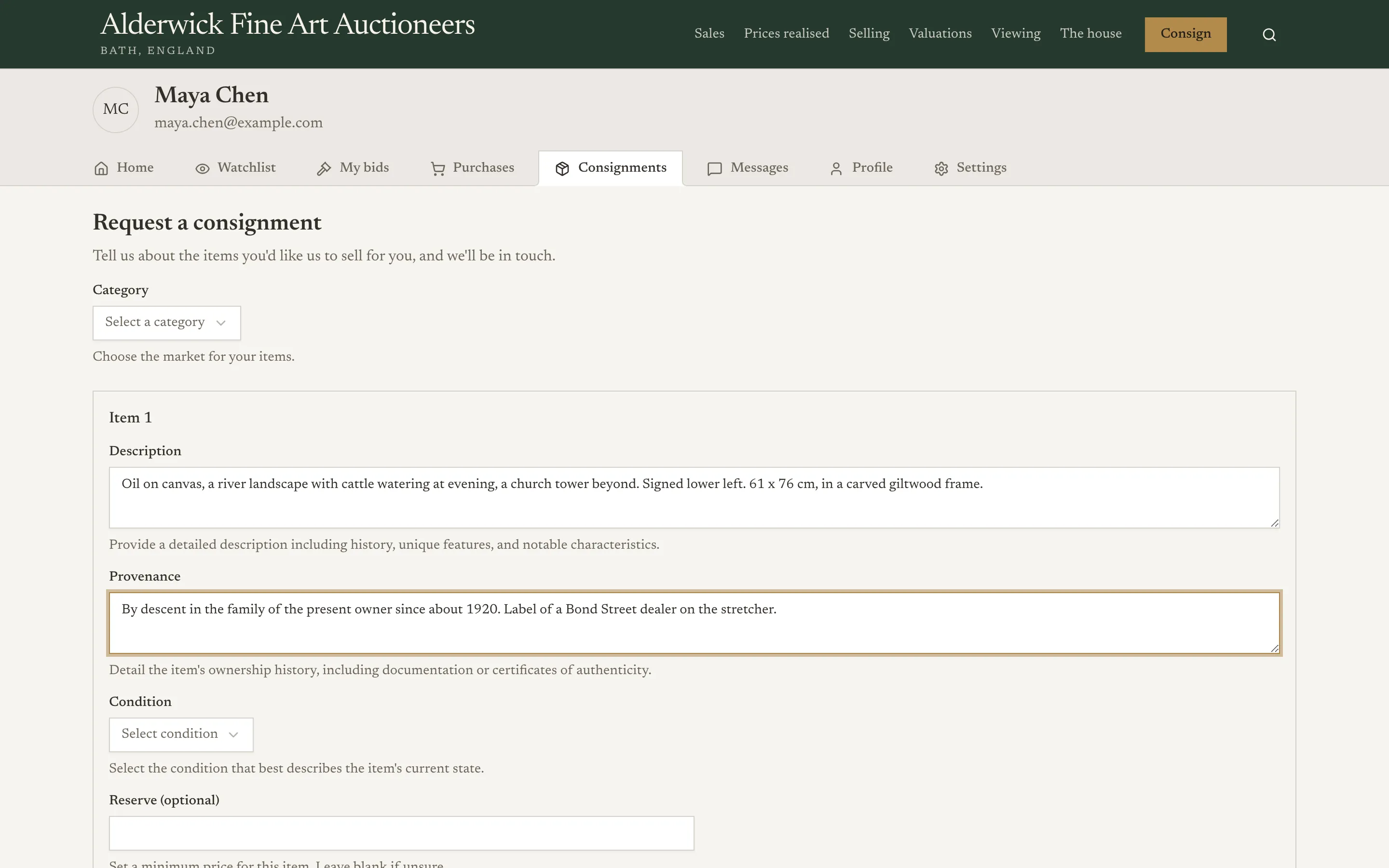
A seller's request on the website of Alderwick Fine Art Auctioneers. Demonstration house.
Everything you would ask for
Description, condition, provenance, a reserve if the seller has one in mind, and up to ten photographs.
A title written for you
AI suggests a catalogue title for each request as it arrives.
Your decision
Approve it at your commission, decline it, or ask the seller for more.
Into a sale
Assign an approved request to a sale and it becomes a draft lot, carrying its description, condition, provenance, reserve and estimates.
2Catalogue
Catalogue each lot once
Write the entry in your trade's words. It appears on your website, in the sale and on the rostrum exactly as you wrote it.
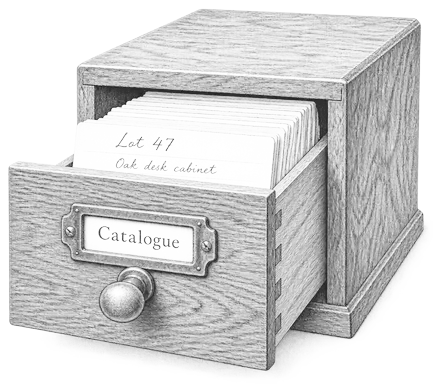
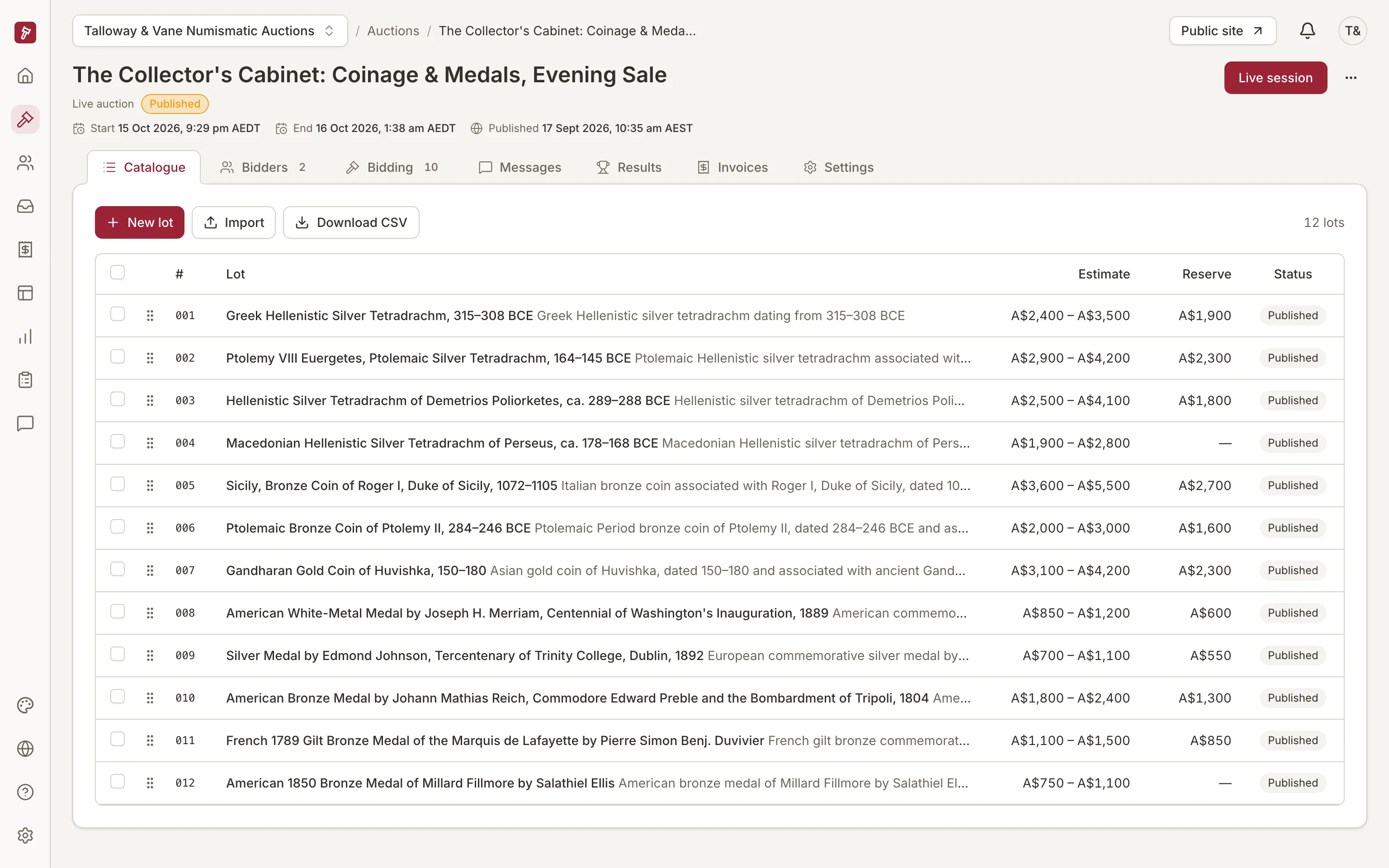
A sale's catalogue at Talloway & Vane Numismatic Auctions. Demonstration house.
Every field a specialist uses
Estimates, reserve, starting bid, condition report, provenance, literature and exhibition history, and a details table you label yourself.
Categories and specialists
Categories you define, and each lot names the specialist for its department.
Photographs in order
Upload every view a bidder needs and drag them into the order they should see.
Spreadsheets in and out
Import lots from a spreadsheet, publish or cancel many at once, and download the catalogue as a spreadsheet.
3Your website
Your website, on your own domain
Your sales, your catalogue and your house's own pages, in your colours and type, at your own address.
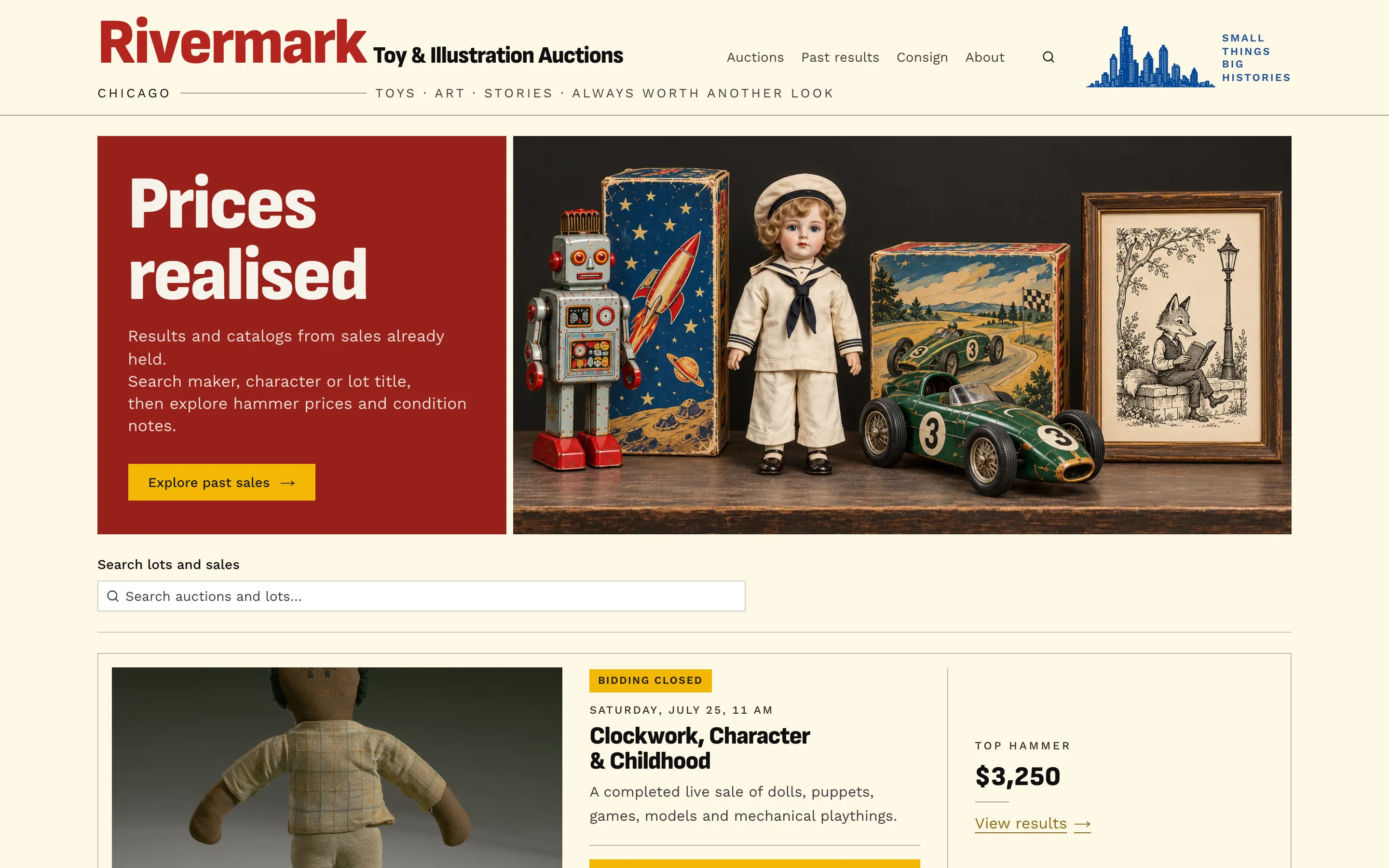
Prices realised at Rivermark Toy & Illustration Auctions. Demonstration house.
Your look
Your logo, colours and typefaces, and a homepage built from a library of sections: the sale calendar, a featured sale, recent results, your specialists, how to visit.
Your pages
The house, selling with you, your conditions of sale, and any page you want to add, written and published from the dashboard.
Checked before it goes public
A sale cannot be published without its dates and details, and you can preview it as bidders will see it.
Prices realised
Past sales stay on your site with their hammer prices, a public record of what your house sells.
4Bidders
Bidders register with your house
Bidders open an account on your website and register for each sale. You decide who bids, as you would at the door.
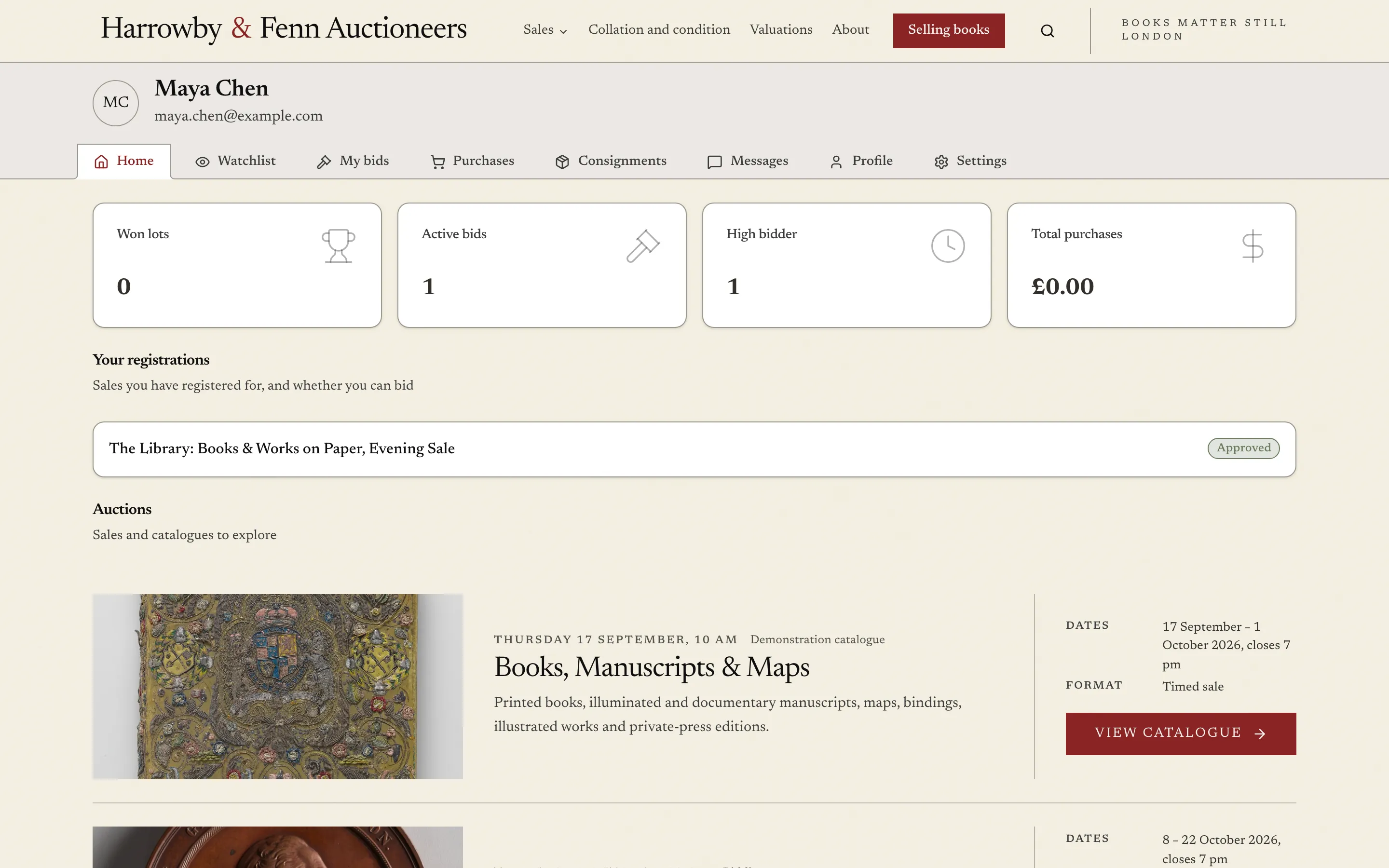
A bidder's account at Harrowby & Fenn Auctioneers, registered and approved for a sale. Demonstration house.
Approval for each sale
Approve, decline with a reason, or block a bidder. Each approved bidder is given a paddle number.
In your name
Emails for approval, outbidding, winning and invoices carry your house's name, not ours.
A reason to come back
A watchlist, with a reminder before a watched lot in a timed sale closes.
Each bidder's history
Their sales, bids, invoices, consignments and your notes in one record, and messages to one bidder or to everyone in a sale.
5Sale day
Timed, live and Dutch sales
Run a timed sale that closes on its own, or take the rostrum with the room and online bidders on the same lot.
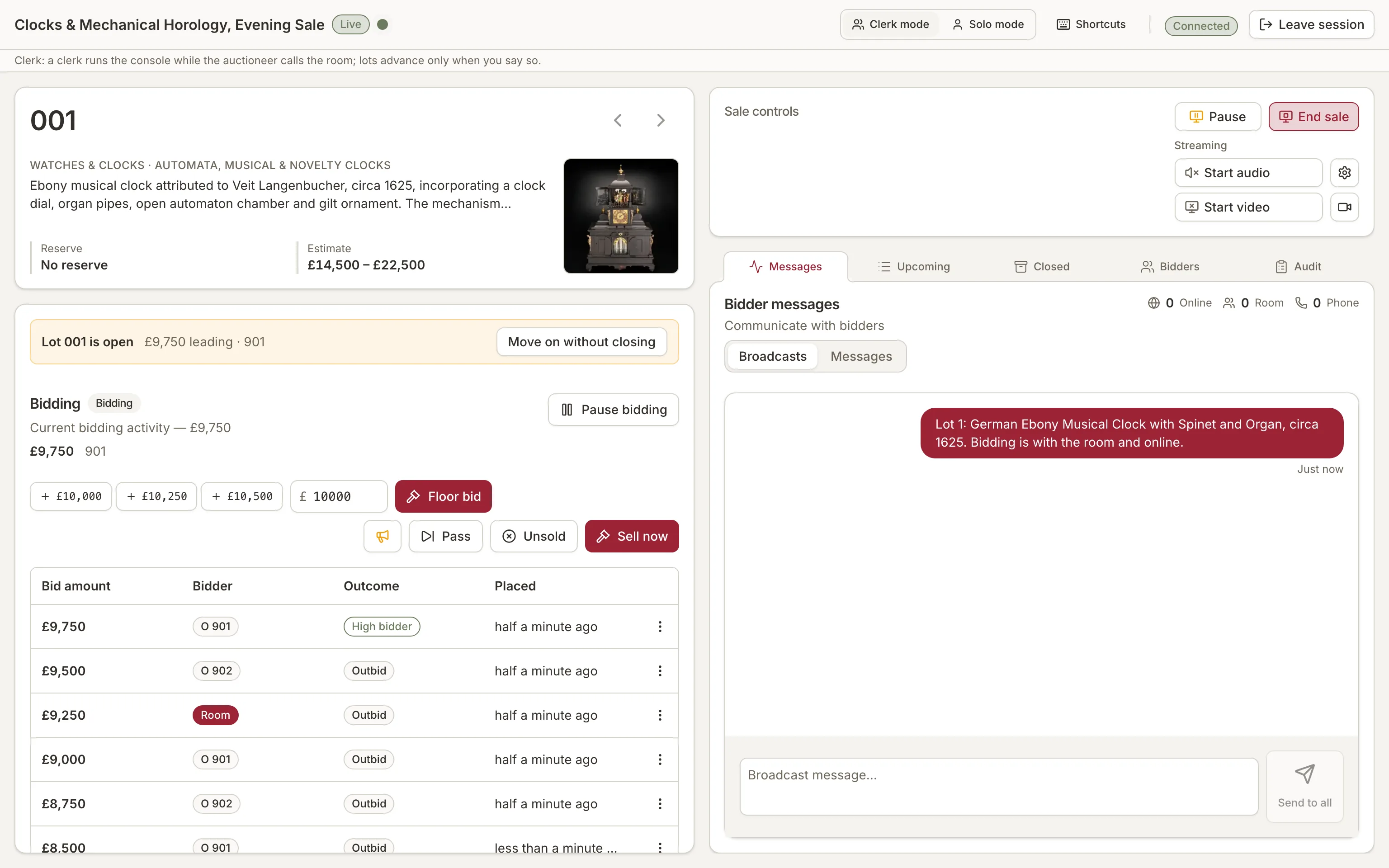
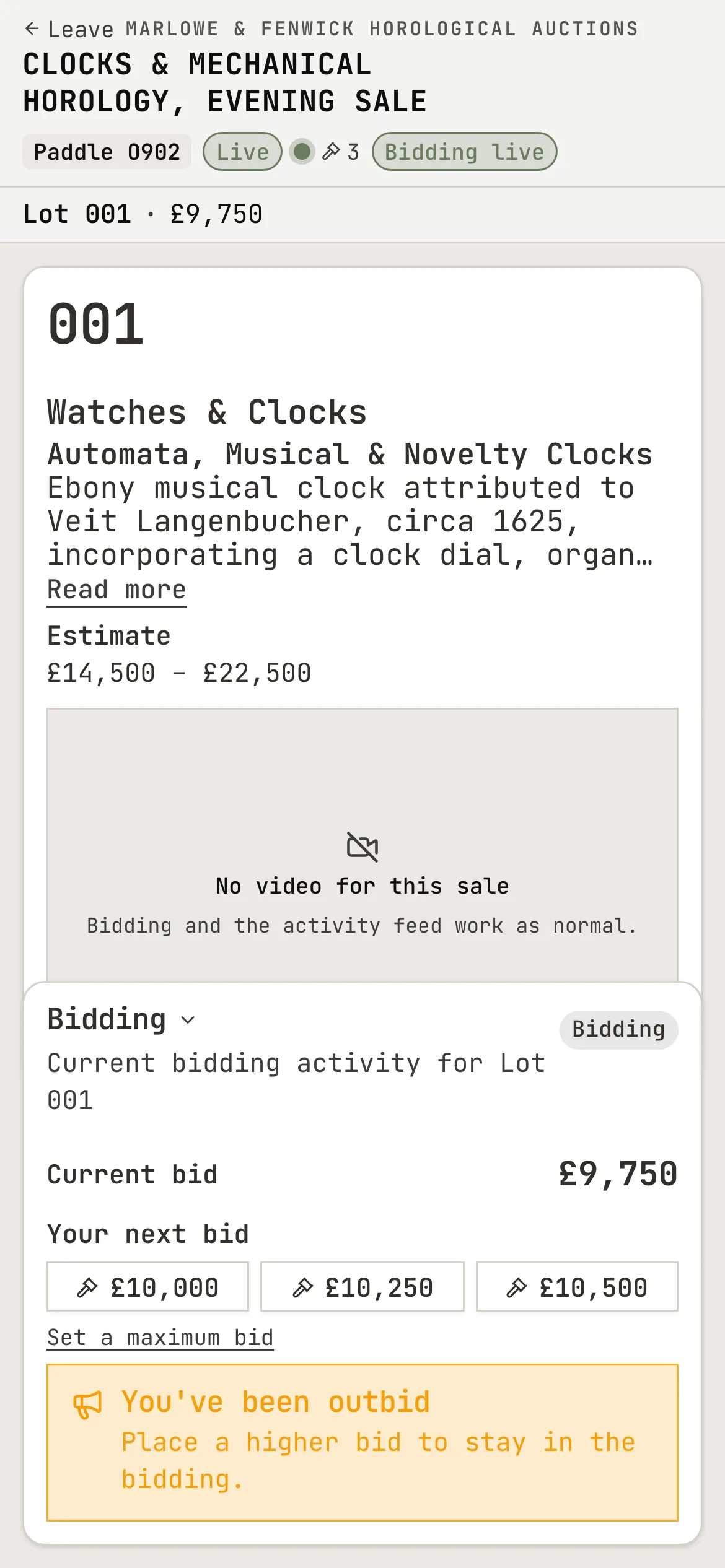
A live sale at Marlowe & Fenwick Horological Auctions: the auctioneer's console, and the same lot on a bidder's phone. Demonstration house.
Timed sales that close fairly
Lots close on schedule, and a late bid extends the close by the minutes you choose.
Live from the rostrum
The auctioneer or clerk calls fair warning, hammers, passes and enters floor bids from one console. Online bidders watch the rostrum on live video and hear the sale.
Absentee bids, both ways
Bidders leave a maximum online, and your staff enter commission bids by hand or from a spreadsheet. The console bids for each, up to their limit.
Your increments, your premium
Bids follow your house's increment table, and every lot page shows your buyer's premium and tax before anyone bids.
Dutch sales
A falling price that steps down to a floor you set, for houses that sell that way.
6After the hammer
Invoices out, and the money straight to you
Invoices go to buyers with your premium and tax, and buyers pay your house directly.
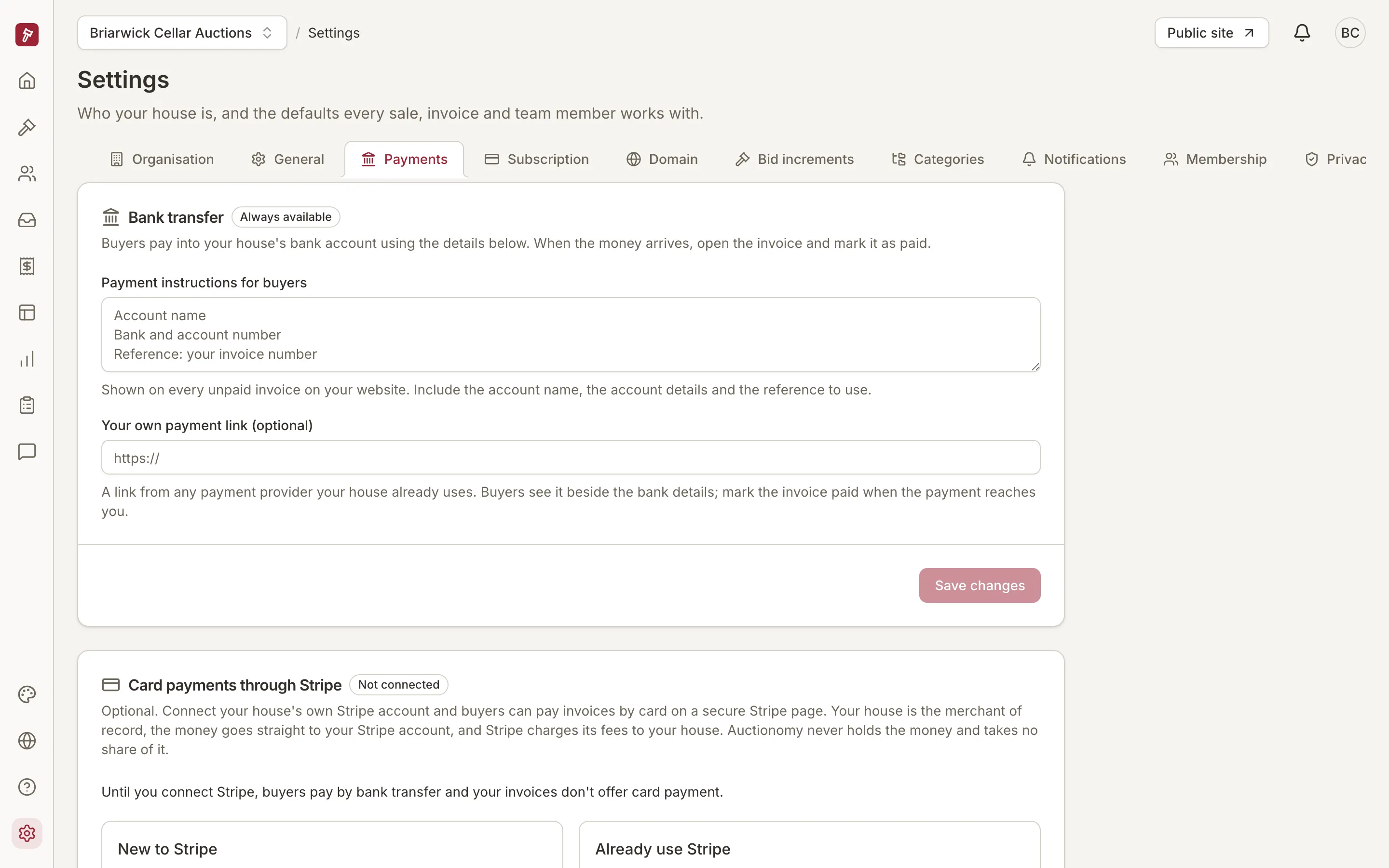
How buyers pay Briarwick Cellar Auctions: bank transfer always, and card once the house connects its own Stripe account. Demonstration house.
Invoices from the result
Raised for each lot at the hammer or for the whole sale, with your buyer's premium, flat or tiered, and tax.
Sent and followed up
Buyers receive each invoice by email and in their account, with a PDF. Overdue invoices are flagged, and you can void and re-bill.
Bank transfer
Your bank details appear on every unpaid invoice, and you mark it paid when the money arrives.
Card, through your own Stripe account
Connect your house's Stripe account and buyers pay by card, straight to you. Auctionomy never holds the money.
7Running the house
Your team, your figures, your records
Everything behind the counter: who can do what, how your sales are going, and what was changed and by whom.

Your team
Invite staff as an administrator or a read-only member. The owner alone handles billing, payment details and the domain.
How your sales are going
Hammer totals, sell-through and bidder numbers over seven, thirty or ninety days, each chart downloadable as a spreadsheet.
A record of every change
An audit log of who did what, for the whole house and for each sale.
Bidders' data, handled properly
Export or erase a bidder's records when they ask.
Help for staff and bidders
Guides for your team in the dashboard, and help pages for bidders on your website.
Notified as it happens
New registrations, payments, enquiries and the end of a sale, by email or in the dashboard, as each person on your team prefers.

See it on your own catalogue
Send us a recent sale and we will show you how it runs on Auctionomy, under your own name.