Condition is read word by word
Chips, frits, hairline cracks, firing faults, rubbing to gilding, restoration seen under UV. A ceramics bidder will not leave an absentee bid on a lot whose condition line is vague.
Markets · Ceramics & Glass
Ceramics and glass buyers read the condition line first and the mark second. Auctionomy gives your house a lot page that holds both, and a website your bidders know is yours.
How your bidders buy
Chips, frits, hairline cracks, firing faults, rubbing to gilding, restoration seen under UV. A ceramics bidder will not leave an absentee bid on a lot whose condition line is vague.
A factory mark, an impressed potter's seal or an etched signature on glass places the piece. Where a mark is later or doubtful, the catalogue says so.
Collectors of studio pottery look for the potter, the glaze and the form; porcelain collectors for the factory and the decoration; glass collectors for technique and maker. Your catalogue groups them that way.
Catalogued your way
Description, estimate, condition and provenance are separate parts of every lot on Auctionomy, and each one shows on the lot page. The entry shown here is an illustration, written the way the trade writes it.
Illustrative lot · fictional
Of compressed globular form with a narrow neck, covered in a tenmoku glaze breaking to rust at the shoulder. 21 cm high.
Estimate NZ$400–600
Your sale on Auctionomy
Condition notes sit apart from the description and show on the lot page, so a hairline is stated once and plainly, next to the photographs that show it.
Add the base and its mark, the rim against the light, the detail of a repair. Bidders compare them without asking you to send more.
Group porcelain, studio pottery and glass, or factory by factory, and bidders filter the catalogue or search for a potter's name.
Bidders leave an absentee bid and the engine bids for them to their limit. In a timed sale, a late bid extends the close.
Your trade, your house
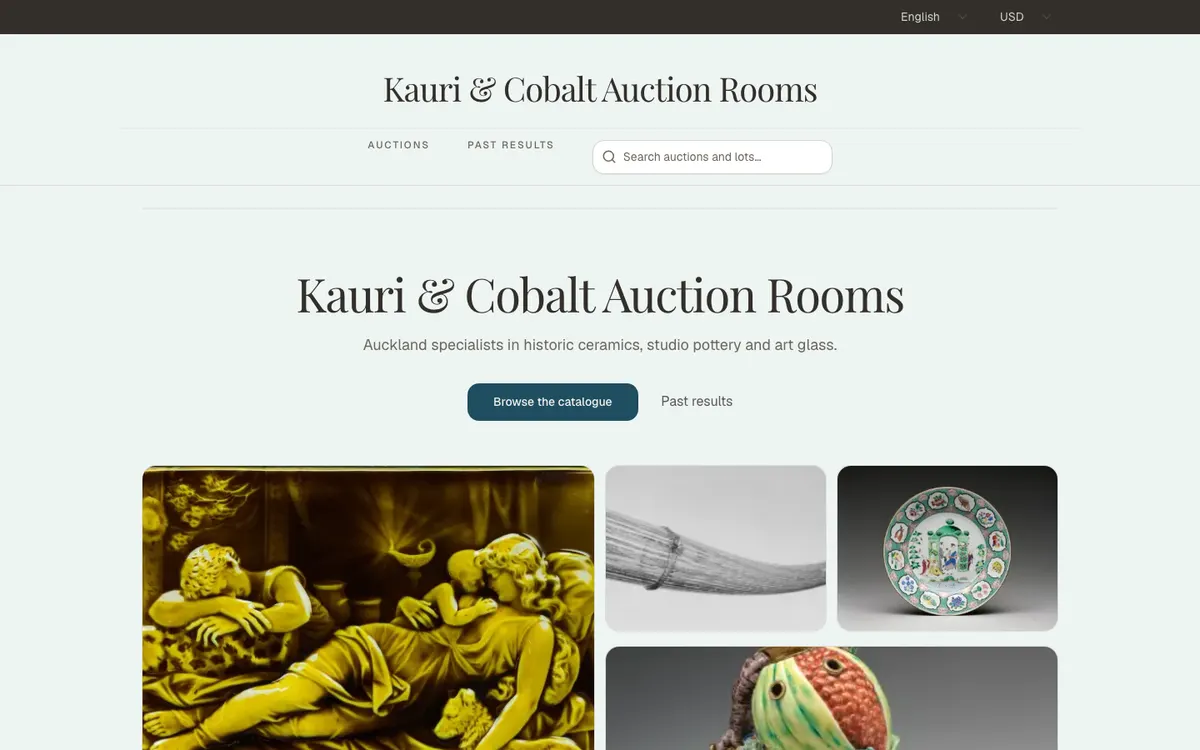
Kauri & Cobalt Auction Rooms is a demonstration house: fictional, built on Auctionomy to show how a house specialising in ceramics & glass looks on the platform. Its name, colours, typeface and page layout are its own, assembled from the same components every house uses. Yours would carry your name, your logo and your look, on your own domain.
A flat subscription, agreed with your house. Your bidders register with you, and the buyer's premium you set is yours.