The marks tell the story
Maker's mark, standard mark, assay office and date letter: together they place a piece in time and place, and bidders check them against the photographs.
Markets · Silver & Metalware
A silver buyer reads the hallmarks before the description. Auctionomy lets your house set out maker, standard, assay office and weight exactly as you catalogue them, on a website that is unmistakably yours.
How your bidders buy
Maker's mark, standard mark, assay office and date letter: together they place a piece in time and place, and bidders check them against the photographs.
Serious bidders expect the weight, usually in troy ounces or grams, alongside the dimensions. For loaded or weighted pieces, the catalogue says so.
Rubbed marks, later engraving or erased armorials, re-gilt interiors and repairs all affect value, and specialist buyers expect them in the condition report.
Catalogued your way
Description, estimate, condition and provenance are separate parts of every lot on Auctionomy, and each one shows on the lot page. The entry shown here is an illustration, written the way the trade writes it.
Illustrative lot · fictional
Of baluster form with a gadrooned rim, leaf-capped spout and a fruitwood scroll handle, the body engraved with a later crest. 28 cm high; 26.4 oz all in.
Estimate £1,200–1,800
Your sale on Auctionomy
Place, period, maker, standard and form lead the title the way your house writes them. Weight and dimensions go in the description.
Add as many images as a lot needs, including close views of each mark and any engraving, so bidders can read them for themselves.
Wear to marks, erased crests and later alterations go in the condition notes; a presentation inscription or family descent goes in provenance.
Set your own increment table and buyer's premium, accept absentee bids, and run the sale timed or live from the rostrum.
Your trade, your house
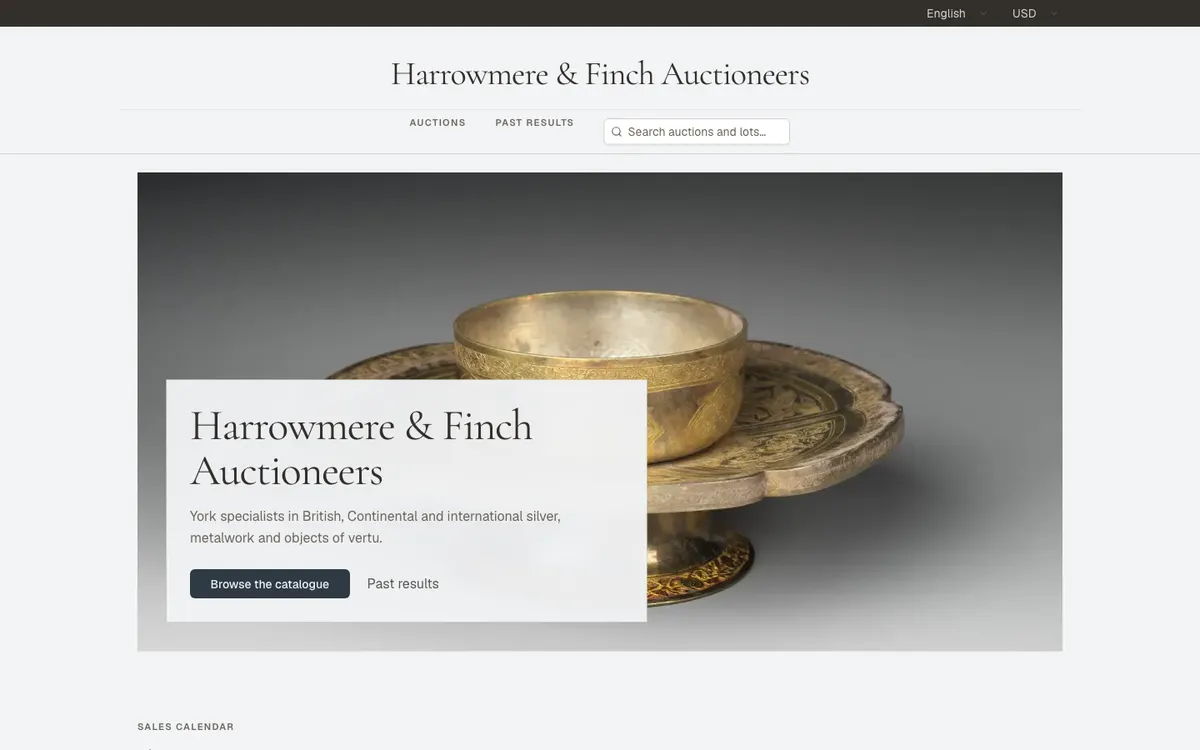
Harrowmere & Finch Auctioneers is a demonstration house: fictional, built on Auctionomy to show how a house specialising in silver & metalware looks on the platform. Its name, colours, typeface and page layout are its own, assembled from the same components every house uses. Yours would carry your name, your logo and your look, on your own domain.
A flat subscription, agreed with your house. Your bidders register with you, and the buyer's premium you set is yours.