Culture and region, named precisely
A specialist catalogue names the people and the place an object comes from, not a continent. Bidders, and the communities concerned, expect that care.
Markets · Indigenous & Ethnographic Art
In this field the history of an object is as important as the object, and the communities it comes from are part of that history. Auctionomy gives your house room to set out culture, provenance and your own due diligence on every lot.
How your bidders buy
A specialist catalogue names the people and the place an object comes from, not a continent. Bidders, and the communities concerned, expect that care.
Field collection, early collection histories, museum deaccession records and old exhibition labels are what bidders look for, and gaps are noted honestly.
In Aotearoa New Zealand, taonga tūturu may only be sold through a dealer or auctioneer once they hold a certificate of examination, and only to a registered collector or public museum. Some cultures and items are not appropriate to offer at all, and your house decides with care.
Catalogued your way
Description, estimate, condition and provenance are separate parts of every lot on Auctionomy, and each one shows on the lot page. The entry shown here is an illustration, written the way the trade writes it.
Illustrative lot · fictional
The caryatid figure kneeling and supporting the curved rest on her head, the coiffure finely carved in a cross form. 16.5 cm high.
Estimate NZ$3,000–5,000
Your sale on Auctionomy
Each lot has a description and a provenance field shown on the lot page, so the collection history and any certification are part of what bidders read.
Bidders register with your house and you approve each one, so your house knows who it is dealing with before a bid is placed.
Define your own categories, by region, culture or object type, so your catalogue keeps the distinctions your specialists make.
Run the sale timed with an extended close, or live with absentee bids left in advance, on your own website and domain.
Your trade, your house
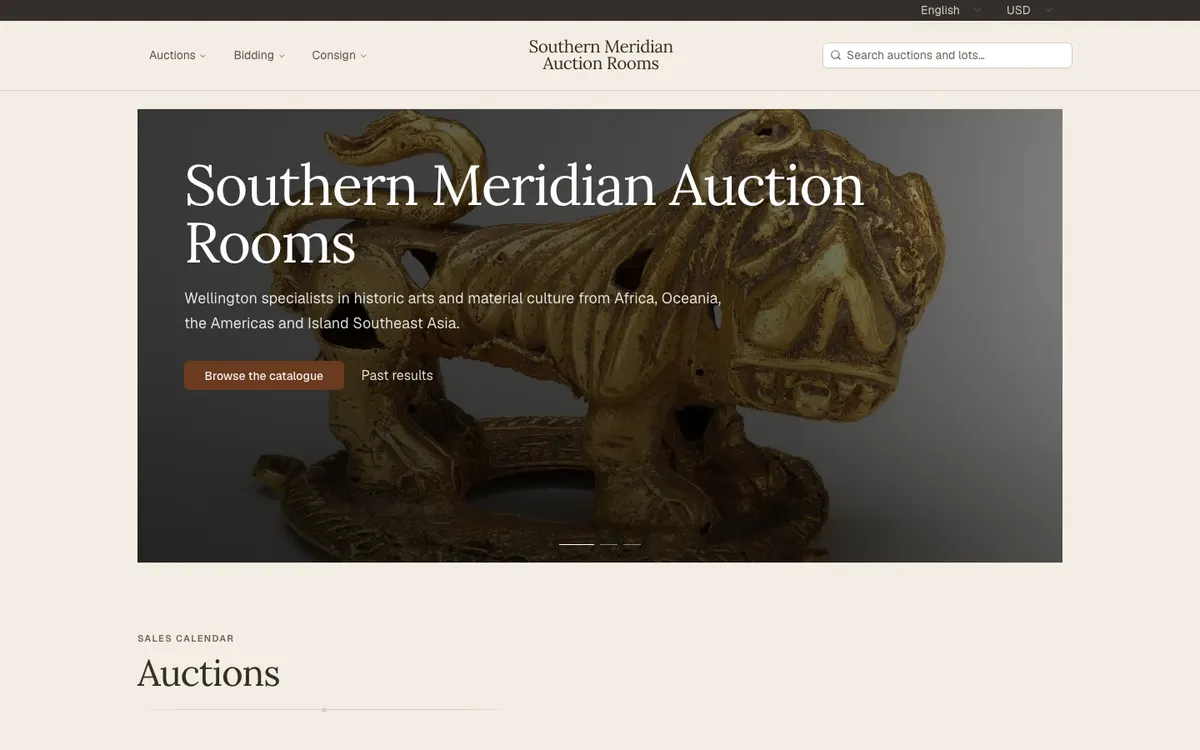
Southern Meridian Auction Rooms is a demonstration house: fictional, built on Auctionomy to show how a house specialising in Indigenous & ethnographic art looks on the platform. Its name, colours, typeface and page layout are its own, assembled from the same components every house uses. Yours would carry your name, your logo and your look, on your own domain.
A flat subscription, agreed with your house. Your bidders register with you, and the buyer's premium you set is yours.